
Why Youth Exposure to Tobacco Products and Marketing Matters
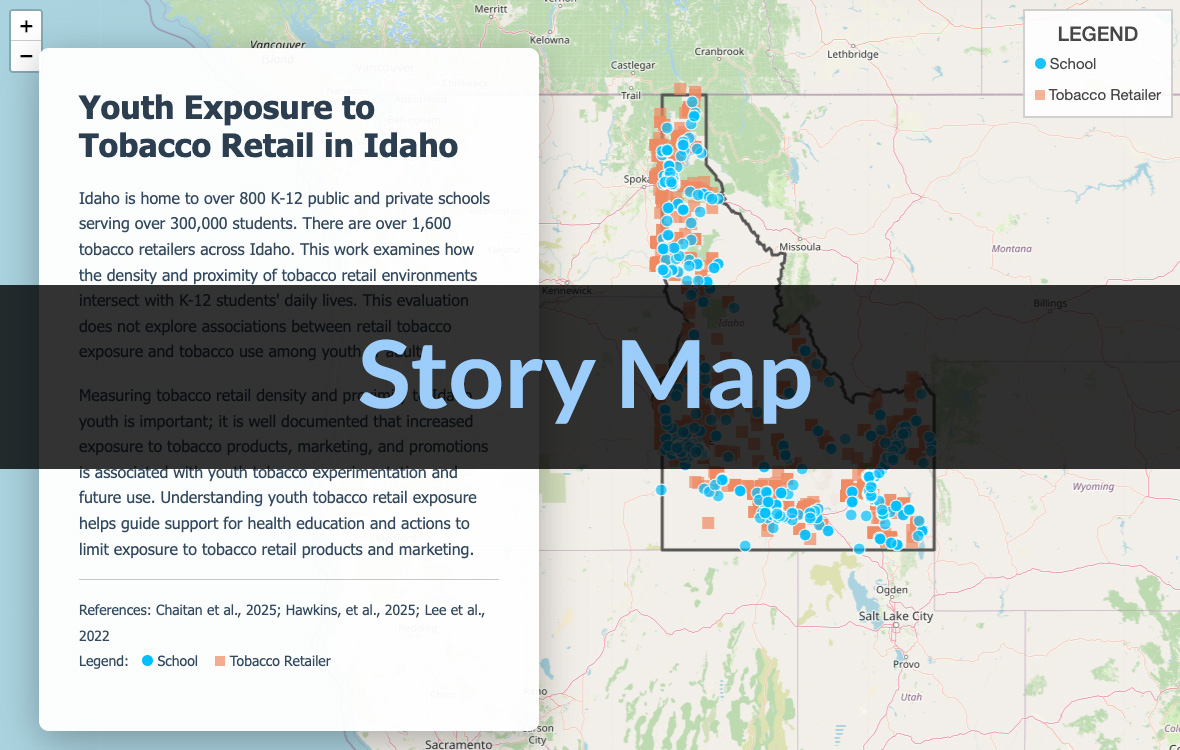
Get started with our story map!
The story map provides an introduction to our analysis of youth exposure to tobacco. After viewing the story map, return here to explore the data in more detail.
The tobacco retail environment, including convenience stores, gas stations, tobacco/vape shops, and other outlets, is the primary setting for the selling and marketing of tobacco/nicotine products. Youth are especially susceptible to tobacco access and marketing. Research supports that easy access to tobacco products, tobacco displays, discounts, and advertisements normalizes tobacco use, and increases the chances youth will try tobacco and use tobacco in the future. Retail exposure to electronic-cigarette (vape) ads is linked to a higher likelihood of vape use, vape brand preference, and a perception that vapes are less harmful than cigarettes.
A higher density of tobacco retailers (especially around schools and youth-oriented locations) is associated with impulse (unintended) purchases, increased youth and adult tobacco use rates, and less successful quit attempts. Research shows that tobacco retail and marketing is more concentrated (dense) in predominantly racially diverse and low-income communities.
Tobacco / Schools Map
The interactive map below shows a variety of tobacco-related information from 2023-2025, as well as proximity to schools. Click any marker or polygon on the map for details.
Click the magnifying glass button (upper left on map) to enter a city name. Use the autocomplete text to make your selection. The map will then zoom to the location of interest.
Map Controls
County-Level Summaries
Select County:
Ada County
Tobacco Retail Summary
Tobacco retailers in Ada County
retailer(s) per 1,000 people
of retailers are within 500 ft of another retailer
of retailers are within 1,000 ft of another retailer
Average Tobacco Spending per Household (2025) in Ada County

ESRI Demographics, Vintage 2025
K-12 School Summary
Schools in Ada County
(includes public & private schools)

of schools are within 1,000 ft of at least one tobacco retailer
Income
Median Household Income (2025)
in Ada County

ESRI Demographics, Vintage 2025
K-12 Student Summary
Students in Ada County
(includes public & private school students)

of students are within 1,000 ft of at least one tobacco retailer
District-Level Summaries
Select School District Boundary:
Tobacco Retail Summary
Tobacco retailers
retailer(s) per 1,000 people
of retailers are within 500 ft of another retailer
of retailers are within 1,000 ft of another retailer
K-12 School Summary
Total schools
(includes public & private schools)
of schools are within 1,000 ft of at least one tobacco retailer
K-12 Student Summary
Total students
(includes public & private school students)
of students are within 1,000 ft of at least one tobacco retailer
Data Sources
| Population estimates (2024, 2025) Consumer Spending Tobacco (2025) Median Household Income (2025) |
ESRI Demographics Vintage 2025 |
| School districts, school district populations | SAIPE 2023 |
| Public and Private School Data (2023-2024) | National Center for Education Statistics (NCES) [ public, private ] |
| Tobacco retailer names, locations (2024) | Personal email from Idaho Department of Health and Welfare |
| Area Deprivation Index (ADI) | Neighborhood Atlas |
Definitions and Descriptions
Idaho Tobacco Retailer — a licensed seller of tobacco and vape products who is legally responsible to prevent sales to minors and to comply with all tobacco control laws. To legally sell any substance containing, made of, or derived from tobacco or nicotine; or electronic smoking devices, the retailer must have an Idaho Tobacco Permit, issued by the Idaho Department of Health and Welfare, Idaho Tobacco Project.
The Idaho Tobacco Retailer data was obtained by the Idaho Tobacco Project, 2024. Web search techniques were used to identify unlicensed tobacco retailers.

Idaho Schools — all public, private, and Tribal Schools in Idaho serving K-12th grade. Colleges, universities, and trade/vocational schools are not included in this report. Idaho has approximately 845 public, private and Tribal K-12th grade schools serving approximately 320,000 students. Names, addresses and enrollments of public and private schools (2023-2024) were obtained from the National Center for Education Statistics (NCES) (specifically, public school data, private school data).
Tobacco Retailers by Type — the Idaho Tobacco Project lists tobacco retailers by the following types: Convenience Stores/Gas Stations, Tobacco/Vape Shops, Grocers, Bar/Lounges, Drug Store/Pharmacy, Department/Discount Store, Restaurant, and Other. The majority of Idaho tobacco retailers are Convenience Stores/Gas Stations (50.8%) with tobacco/vape shops the next highest, (15.2%).
There were approximately 1,660 tobacco retailers in Idaho according to the Idaho Tobacco Project (2024).
Tobacco Retail Density — describes the overall concentration of tobacco retailers across a defined area (e.g. school district, city, or county).
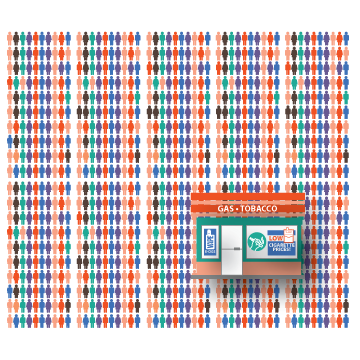
Describing tobacco retail density by a specific population size allows for comparisons across populations of different sizes. A common tobacco retail density measure is the number of tobacco retailers per 1,000 people (Centers for Disease Control and Prevention [CDC], 2019). This analysis measures the density of Idaho tobacco retailers per 1,000 people at both the county and school district level.
Measuring tobacco retail density provides important information on tobacco accessibility, normalization of tobacco use, and exposure to tobacco sales and promotion. High tobacco retail density is associated with high tobacco sales and marketing (CDC, 2024) high tobacco use (Lee et al., 2022), lower tobacco cessation success (Chaitan et al., 2025), and increased youth vape use in areas of high walkability (Harlow et al., 2025). Higher tobacco retail density is often disproportionally greater in neighborhoods with lower incomes and high minority populations (Golden et al., 2025) and in rural areas where convenience stores often serve as a community hub (Webb et al., 2025, U.S. Department of Health and Human Services [HHS], 2024).
There are 0.83 tobacco retailers per 1,000 people in Idaho.
Tobacco Retail Proximity — describes the number and/or percentage of tobacco retailers within a specific distance from a specific location.
Proximity to Schools - A commonly used measure is 1,000 feet between tobacco retail and schools and other youth-oriented locations (CDC 2019, Ribisl et al., 2017). 1,000 feet is about 2-3 city blocks and a 3-4-minute walk on level ground. This interactive report allows the user to identify:
- Schools within 1,000 feet of at least one tobacco retailer.
- The percentage and the number of students in a specific school district that are within 1,000 feet of at least one tobacco retailer.
Measuring proximity of tobacco retailers to youth-oriented locations provides important information on youth's frequent exposure to tobacco products, and highly-visible tobacco marketing and promotion (Ribisl et al., 2017). In Idaho, 19.6% of schools (approximately 58,600 students) are within 1,000 feet of at least one tobacco retailer.
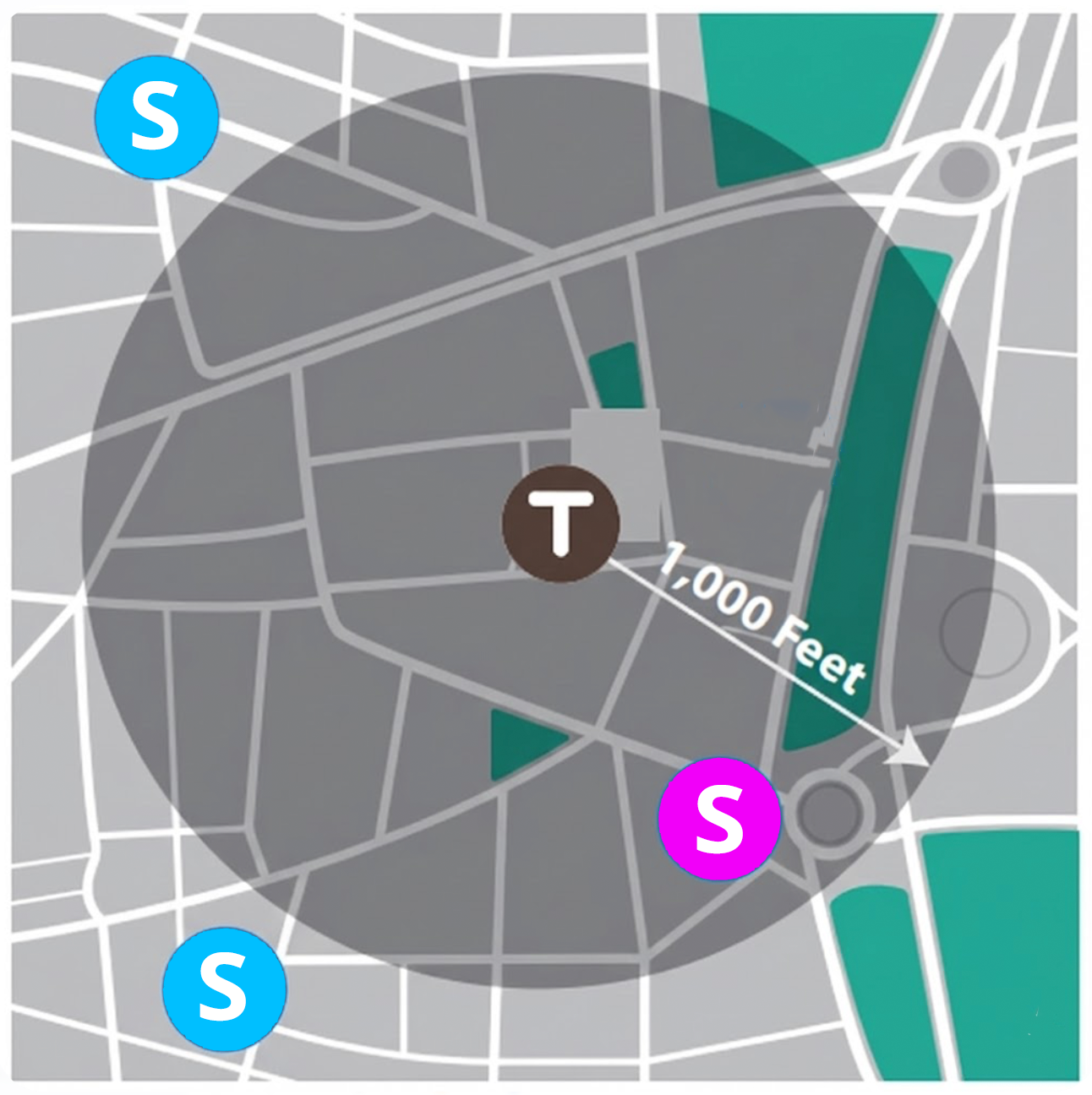
| Tobacco Retailer | |
| School within 1,000 ft of tobacco retailer |
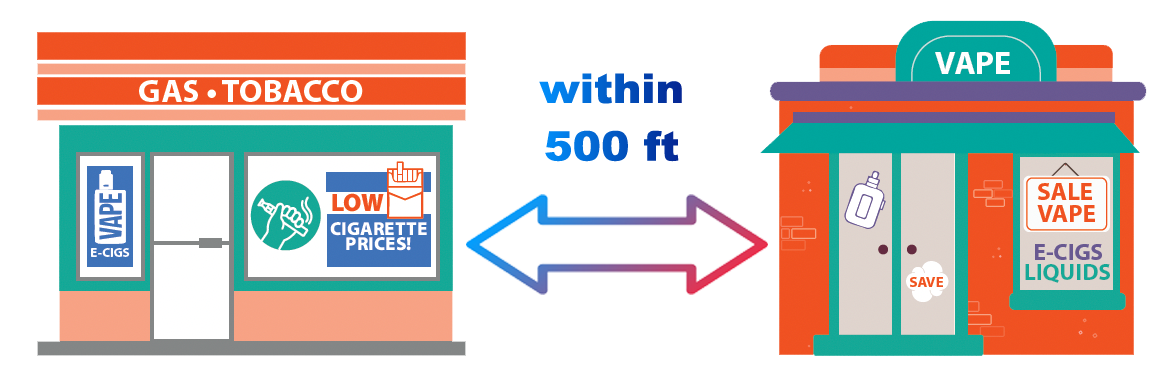
Proximity Between Tobacco Retailers - The distance between tobacco retailers is a second common proximity measure. There is no legal or accepted standard for the distance between tobacco retailers in Idaho. A common measure of high tobacco retail proximity is less than 500 feet between retailers. This report provides the percentage of tobacco retailers within 500 feet of one another by county and by school district.
Research supports that clustering of tobacco retail is associated with higher tobacco craving and use (Muzekari et al., 2025, Wagoner et al., 2020), decreased tobacco quitting success (Santiago-Torres et al., 2025), and early tobacco initiation and youth use (Cantrell et al., 2016).
Household Tobacco Spending by County — The analysis of household tobacco spending is based on data derived from Esri's Tapestry Segmentation System. Esri uses a proprietary model that integrates data from the U.S. Bureau of Labor Statistics (BLS) Consumer Expenditure Surveys (CEX) with other demographic and socioeconomic data. Esri's household tobacco spending data refers to estimates of the total and average amount that households spend annually on tobacco products within a specific geographic area. Tapestry data is representative of general community-level trends and is not intended to describe behaviors at an individual level. Household Tobacco Spending by County is not based on actual sales data, public health surveys, or tobacco expenditures among people who use tobacco.
Generally, household tobacco spending by county is a helpful indication of tobacco use in a population. The actual annual cost of tobacco use is much higher than the House Tobacco Spending by County measure. For example, an Idahoan smoking one pack a day of Marlboro cigarettes would spend approximately $2,920 ($8.00 per pack x 365 days) per year on direct costs. This estimate does not include the total financial burden of the cost of smoking (Shrestha et al., 2022).
Household Income — The sum of the pretax cash income for all people aged 15 and older living in the same housing unit, whether they are related or not, as defined by the U.S. Census. Household income includes all wages, salaries, self-employment, investments, Social Security, and cash benefits. It does not include non-cash benefits like health insurance or food assistance.
Median Household Income - The middle income point of a specified area, e.g., city, county, or state, where exactly half of the households earn more money and half earn less. Median Household Income represents a typical income. It is considered a better indicator of income than average income because it is not skewed by high- or low-income extremes.

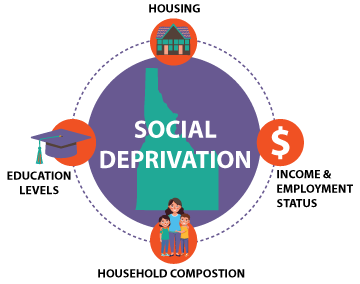
Area Deprivation Index (ADI) — A scientifically validated tool that ranks neighborhoods by social disadvantage by looking at factors beyond just income. The ADI combines data on income, employment, education, and housing to determine an ADI score between 1 (lowest deprivation) and 10 (highest deprivation). The ADI is successfully used to identify, evaluate, and improve factors that impact health and quality of life across populations (Kind & Buckingham, 2018). Research supports that low-income and minority neighborhoods can have up to five times more tobacco retailers than high income areas (Ribisl et al., 2017).
Area Deprivation Index data are from the Neighborhood Atlas.
Credits
Idaho's Tobacco Retail Environment: Measuring Youth Exposure was
sponsored by Project Filter, Idaho's Tobacco Prevention and Control Program, Bureau
of Community Health, Division of Public Health, Idaho Department of Health and Welfare
and supported by the Idaho Millennium Fund.
University of Idaho Project Team: Helen Brown | Principal Investigator,
Felix Liao| Co-Investigator, Jennifer Hinds | Website/Story Map Develper, Julene Ewert |
Graphic Design, Kathryn Pawelko | Editorial Oversight.
For more information, email:
ProjectFilter@dhw.idaho.gov
Suggested citation:
Brown, H., Hinds, J., and Liao, F. (2025). Idaho's tobacco retail environment:
Measuring youth exposure. University of Idaho; Project Filter; Idaho Department
of Health and Welfare. [https://modelingidahohealth.org/tobacco-youth-exposure]
References
Cantrell, J., Pearson, J. L., Anesetti-Rothermel, A., Xiao, H., Kirchner, T. R., & Vallone, D. (2016). Tobacco retail outlet density and young adult tobacco initiation. Nicotine & Tobacco Research, 18(2), 130–137. https://doi.org/10.1093/ntr/ntv036
Centers for Disease Control and Prevention. (2019). A guide to the types of data needed to formulate local retail tobacco control policy. Preventing Chronic Disease, 16, 180282. https://www.cdc.gov/pcd/issues/2019/18_0282.htm
Centers for Disease Control and Prevention. (2024, September 17). Economic trends in tobacco. https://www.cdc.gov/tobacco/php/data-statistics/economic-trends/index.html
Combs, T. B., Ornstein, J. T., Chaitan, V. L., Golden, S. D., Henriksen, L., & Luke, D. A. (2022). Draining the tobacco swamps: Shaping the built environment to reduce tobacco retailer proximity to residents in 30 big US cities. Health & Place, 75, 102815. https://doi.org/10.1016/j.healthplace.2022.102815
Harlow, A. F., Thompson, L. K., Eckel, S. P., Leventhal, M. A., Haley, D. F., Roberts, M. E., Cockburn, M. G., & Barrington-Trimis, J. L. (2025). Prospective association of tobacco retailer density and neighborhood walkability with youth vaping initiation in California, USA. Tobacco Control. Advance online publication. https://doi.org/10.1136/tc-2024-058974
"Economic Trends in Tobacco." Centers for Disease Control and Prevention. Accessed December 14, 2025. https://www.cdc.gov/tobacco/php/data-statistics/economic-trends/index.html
Gaiha, S. M., Lempert, L. K., & Halpern-Felsher, B. (2025). Trends in youth tobacco use and the rural-urban gap: The hardening of daily use. Tobacco Control, 34(1), 45–52. https://doi.org/10.1136/tc-2024-058912
Golden SD, Kuo TM, Kong AY, Baggett CD, Henriksen L, Ribisl KM. County-level associations between tobacco retailer density and smoking prevalence in the USA, 2012. Prev Med Rep. 2019 Oct 31;17:101005. doi: 10.1016/j.pmedr.2019.101005. PMID: 31934535; PMCID: PMC6951276.
Hawkins, M., Edwards, C., Amenyo, B., White, J., Boumatar, K., Ndombo, P. K., Dahlquist, C., & Snelling, A. (2025). Cross-sectional examination of tobacco point-of-sale marketing practices by location and type of retail environment in the District of Columbia. Tobacco Prevention & Cessation, 11, Article 211431. https://doi.org/10.18332/tpc/211431
Kind, A. J. H., & Buckingham, W. R. (2018). Making neighborhood disadvantage metrics accessible: The Neighborhood Atlas. New England Journal of Medicine, 378(26), 2456–2458. https://doi.org/10.1056/NEJMp1802313
Lee, J. G. L., Kong, A. Y., Sewell, K. B., Golden, S. D., Combs, T. B., Ribisl, K. M., & Henriksen, L. (2022). Associations of tobacco retailer density and proximity with adult tobacco use behaviours and health outcomes: A meta-analysis. Tobacco Control, 31(e2), e189–e200. https://doi.org/10.1136/tobaccocontrol-2021-056711
Mantey, D. S., Pasch, K. E., Loukas, A., & Perry, C. L. (2019). Exposure to Point-of-Sale Marketing of Cigarettes and E-Cigarettes as Predictors of Smoking Cessation Behaviors. Nicotine & Tobacco Research: Official Journal of the Society for Research on Nicotine and Tobacco, 21(2), 212–219. https://doi.org/10.1093/ntr/ntx246
Mills, S. D., Kong, A. Y., Reimold, A. E., Baggett, C. D., Wiesen, C. A., & Golden, S. D. (2022). Sociodemographic disparities in tobacco retailer density in the United States, 2000–2017. Nicotine & Tobacco Research, 24(8), 1291–1299. https://doi.org/10.1093/ntr/ntac020
Muzekari, B., Cooper, N., Resnick, A., et al. (2025). Naturalistic tobacco retail exposure and smoking outcomes in adults who smoke cigarettes daily. JAMA Network Open, 8(9), e2530132. https://doi.org/10.1001/jamanetworkopen.2025.30132
Ribisl, K. M., Luke, D. A., Bohannon, D. L., Sorg, A. A., & Moreland-Russell, S. (2017). Reducing disparities in tobacco retailer density by banning tobacco product sales near schools. Nicotine & Tobacco Research, 19(2), 239–244. https://doi.org/10.1093/ntr/ntw185
Sanders-Jackson, A., Parikh, N. M., Schleicher, N. C., Fortmann, S. P., & Henriksen, L. (2015). Convenience store visits by US adolescents: Rationale for healthier retail environments. Health & Place, 34, 63–66. https://doi.org/10.1016/j.healthplace.2015.03.011
Santiago-Torres, M., Mull, K. E., Sullivan, B. M., & Bricker, J. B. (2025). Does living near a tobacco retailer impact the efficacy of smoking cessation treatments?: Analysis from a randomized trial. Addictive Behaviors Reports, 22, Article 100635. https://doi.org/10.1016/j.abrep.2025.100635
Shrestha, S. S., Chen, P.-H., Grosse, S. D., Armour, B. K., Wang, L., Xu, X., & King, B. A. (2022). Economic loss attributable to cigarette smoking in the USA: an economic modelling study. The Lancet Public Health, 7(10), e834–e843. https://doi.org/10.1016/S2468-2667(22)00200-X
Wagoner, K. G., King, J. L., Suerken, C. K., Reboussin, B. A., Ross, J. C., & Sutfin, E. L. (2020). Youth and young adult convenience store behaviors: Findings from intercept surveys. Nicotine & Tobacco Research, 22(5), 794–800. https://doi.org/10.1093/ntr/ntaa098
Webb, E., Craigmile, P. F., Morean, M. E., Kong, G., Lee, J. G. L., Martin, R. J., Barrington-Trimis, J., Qiang, R., Spinola, V. B., & Roberts, M. E. (2025). Tobacco retailer density and rurality across four US states: California, Connecticut, North Carolina, and Ohio. The Journal of Rural Health, 41(3), Article e70073. https://doi.org/10.1111/jrh.12312
U.S. Department of Health and Human Services. (2024). Eliminating tobacco-related disease and death: Addressing disparities—A report of the Surgeon General. U.S. Department of Health and Human Services, Centers for Disease Control and Prevention. Full report